
Gemini Enterprise and Collavate: Building Traceable AI
AI Is Faster, But Who Takes Responsibility?
More and more companies are rapidly adopting generative AI for their daily operations. Ask a question like, “What measures should we take to prepare for security risks in the second half of this year?” and Gemini Enterprise can provide a well-structured answer based on internal company documents within seconds.
But when that answer is used for an actual business decision, one fundamental question remains for executives and security and compliance teams. “Who approved the document behind this answer, when was it approved, and through what process?”
No matter how convincing an AI-generated answer may be, it cannot be fully trusted if its source is an unverified draft or someone’s informal notes. This becomes even more critical for regulated industries such as finance, government, and healthcare, as well as for companies preparing for an IPO, audit, or external reporting. The speed of AI could otherwise become the speed at which unverified information spreads.
The Key Is Not “Training,” but “Citing the Source”
There is an important point to understand first. Gemini Enterprise does not use internal company data to train its models. Instead, it searches documents stored in Google Drive in real time, uses their content as grounding for its answers, and cites the sources it references.
This distinction is critical from a security perspective. It means that the data is not absorbed into the model and lost from view. Instead, the original documents remain intact, while AI simply “references” them. In other words, every AI-generated answer has a source that points to the document where the information came from.
This naturally leads to the next question. Can you trust the source document itself?
Collavate Completes the Final Link — Approval History
This is where Collavate plays a critical role.
Collavate is an electronic approval and document approval solution built for Google Workspace. When a document stored in Google Drive goes through a formal review and approval process with Collavate, its approval history is recorded along with the document. This record shows who submitted the document, which approvers reviewed it and in what order, and when and with what comments each person approved it, all captured through electronic signatures and timestamps.
Now, three elements are connected as a single chain.
① AI Answer → ② Cited Source Document → ③ Approval History of the Document
Follow the source cited by Gemini Enterprise to reach the original document, then open its Collavate approval history to trace back “who approved this information, when it was approved, and what evidence supported the decision.” This makes it possible to trace and audit the foundation of an AI-generated answer all the way back to a record that was reviewed and approved by people.
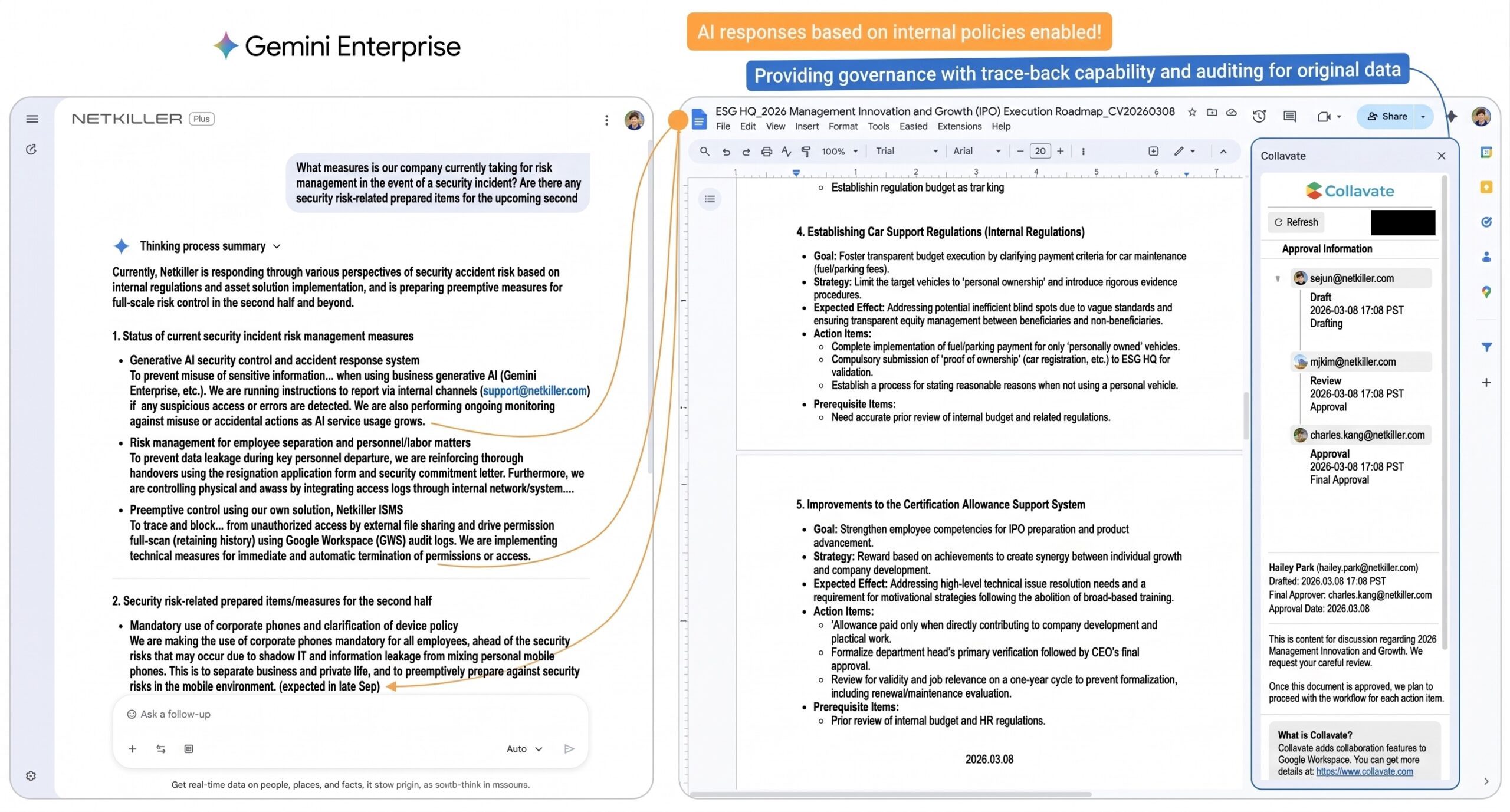
See the Traceability Flow in Action
The example above makes it clear how the process works.
On the left, in the Gemini Enterprise screen, the user asks about “risk management measures in the event of a security incident.” AI provides specific answers, including “generative AI security controls,” “HR and labor risk management for departing employees,” and “proactive monitoring using Netkiller ISMS,” with a Google Drive source icon displayed for each item.
Following those sources leads to the actual document on the right — a formal management roadmap document. The Collavate panel on the right then shows the document’s complete approval history. You can see the records of multiple approvers reviewing and electronically signing the document in sequence, along with the approval timestamps and comments from the submitter.
Ultimately, a single line of information cited by AI is fully supported by an actual approved document and the approval records of the people responsible for that document.
Why This Matters — ‘Human in the Loop’ Governance
The essence of this structure goes beyond simply connecting different features. It establishes a governance framework that keeps human judgment and accountability clearly embedded in the AI workflow.
- Reliability — AI answers are based on verified, approved documents, reducing the risk of unverified information influencing business decisions.
- Audit Readiness — When regulators or auditors ask, “What is the basis for this decision?” you can provide a complete chain from the AI answer to its source document and approval history.
- Clear Accountability — AI can create drafts and provide answers, but the final responsibility remains with the people who approve the documents. A record of who approved what is preserved.
- Security Alignment — Original documents remain securely stored in Google Drive, while Collavate controls permissions and access, allowing organizations to balance AI adoption with information security.
Conclusion
In the era of generative AI, competitive advantage is shifting from “How quickly can we get an answer?” to “How confidently can we trust and take responsibility for that answer?”
When Gemini Enterprise provides answers grounded in internal knowledge and Collavate verifies the approval history behind that knowledge, organizations can finally have AI that is traceable and auditable. AI does the work, while people make the decisions and take responsibility — this is one of the most reliable ways to bring AI into the workplace with confidence.